3D Printer/Bambu Lab P1S
Jump to navigation
Jump to search
Prepare Printer
- First clean the magnetic steel sheet. To do so pull it up on the front edge and spray a few times with isopropyl alcohol on it.
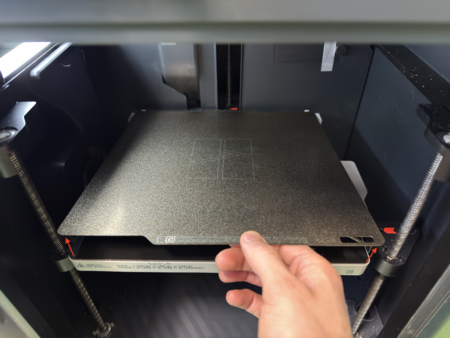

- Wipe it up with a paper towel.

- Place back the steel sheet. Please note the orientation of the plate.
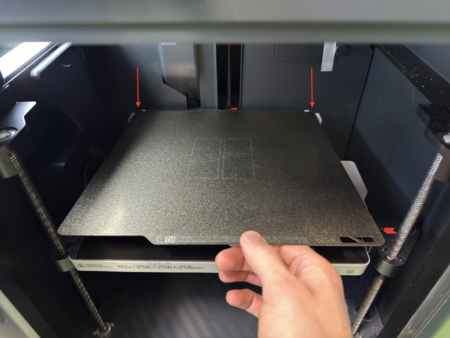


Change Filament
- The printer has an Automatic Material System (AMS), this allows the printer to switch between filaments.
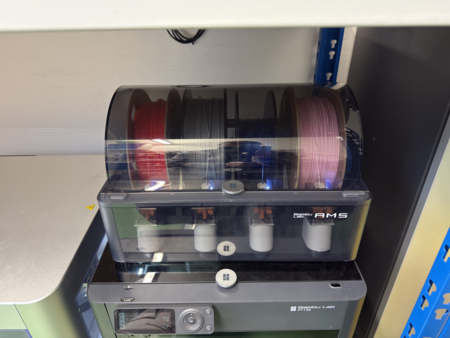
- The order of the filaments is from left to right and can be selected in the Bambu Studio app by entering the number of it (1-4).
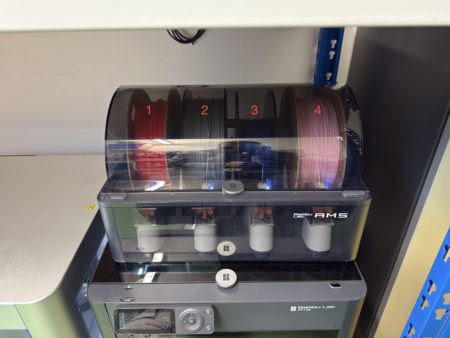
- To change a filament, first open the AMS.
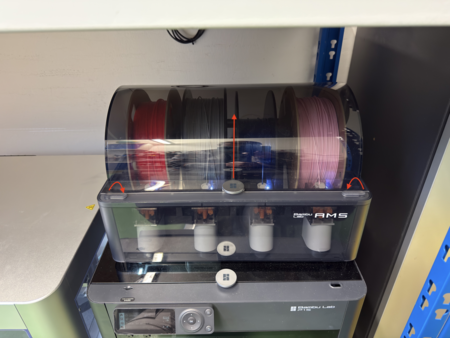

- Please do not change the filament if one of the LEDs is blinking, which means that one of filaments is stuck.

- Gently pull out one of the filaments you do not need.
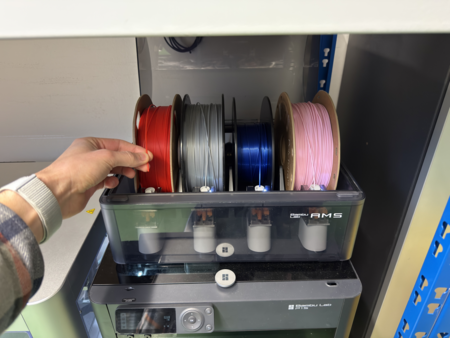
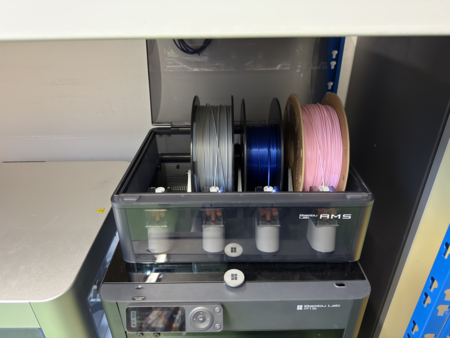
- You can find PLA filament above the printers. Please ask if you are unsure whether you can use a filament.

- Please make sure that you use PLA (type of filament)!

- Cut the filament straight.
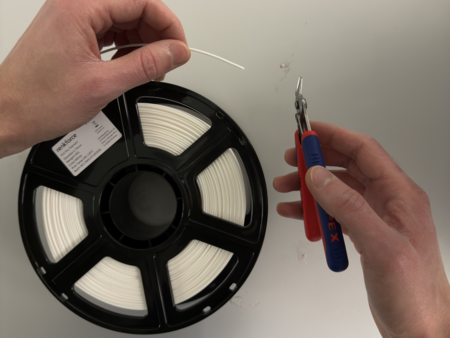
- Now place the new filament in the AMS and insert it until the printer starts pulling it.
- Close the AMS.


Set up Bambu Studio
- To use the printer, you will need an application which converts the 3d model into a file that can be interpreted by the printer.
- Visit https://bambulab.com/en/download/studio and download the application for your OS.
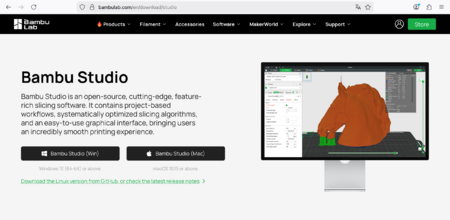
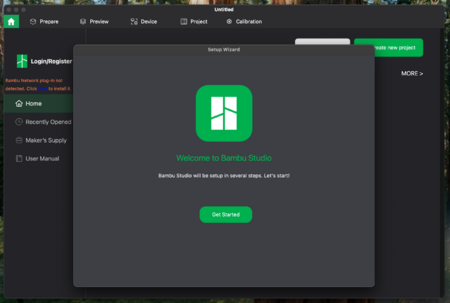
- After that open the app and follow the instructions to set it up.
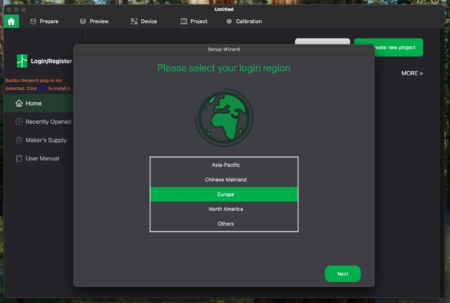
- Set your login region to Europe and click on Next.
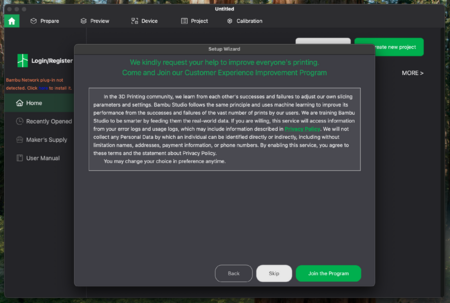
- You will be asked to join their customer experience improvement program. You can skip that.
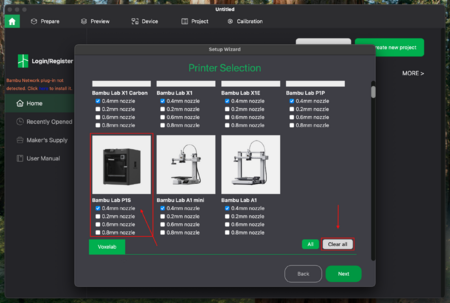
- Click on Clear all to remove all printers as you will only need the settings of the printer that is in the workshop. For that select the Bambu Lab P1S with 0.4mm nozzle and click on Next.
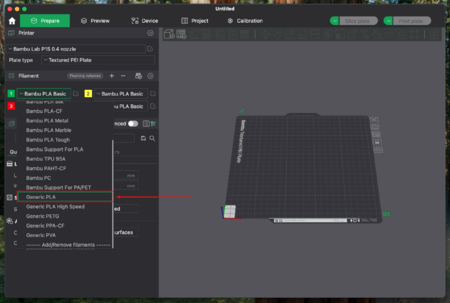
- There are different types of filament that can be used for printing. But for this printer you will always use Generic PLA. Please go through the list and make sure that Generic PLA is selected.
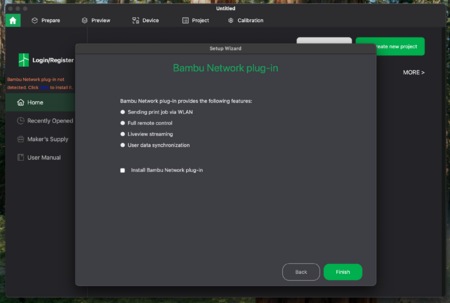
- As this printer is not connected to the network unselect all settings in this step.
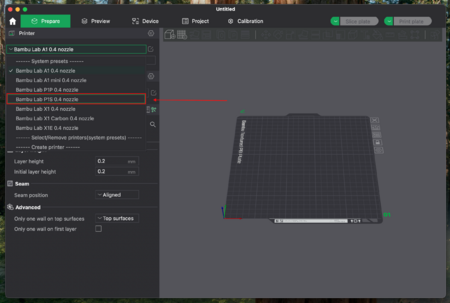
- After that go to the Prepare tab and select the right nozzle of the printer, which is Bambu Lab P1S 0.4 nozzle.
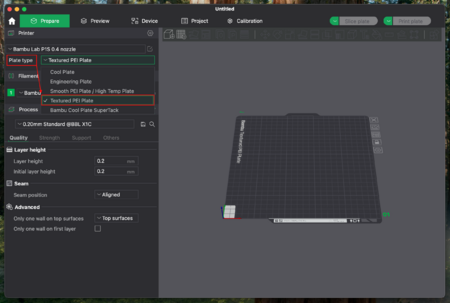
- Set the Plate type to Textured PEI Plate.
- The printer has an AMS (Automatic Material System) so 4 filaments can be used by the printer. To do so add 3 additional filaments by pressing on the cross 3 times.

- Then change the type of filament to Generic PLA for all filaments.
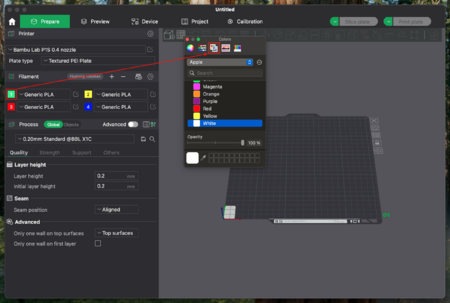
- If you want you can change the color of the filaments, but it is not necessary as it is only for distinguishing which filament you have selected for printing. To change it, just click on the number and select a color.


Your first print with Bambu Lab P1S
- Make sure you have installed the Bambu Studio application before continuing. If not please do all necessary steps in chapter Set up Bambu Studio.
- Before adding your 3D model, please make sure that it is saved in one of these two formats: 3mf or stl. Note that this step has to be done with your modeling application you use.

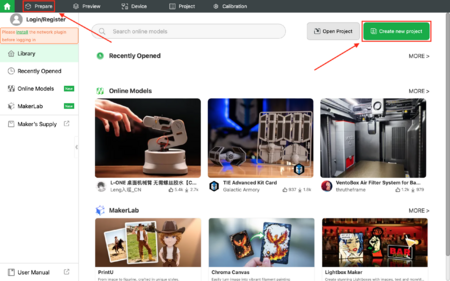
- Open the Bambu Studio application and click on Create new project or go to Prepare.
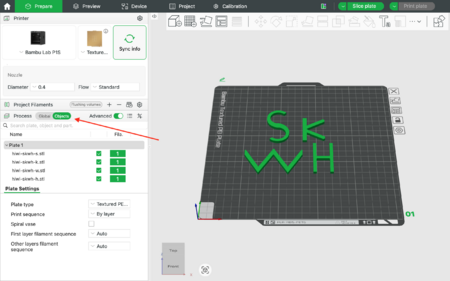
- Drag & drop your 3D model into you new project. Go to Objects tab to see all added models.
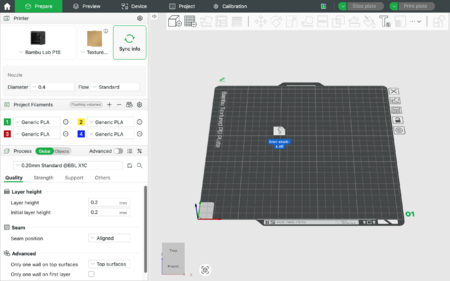
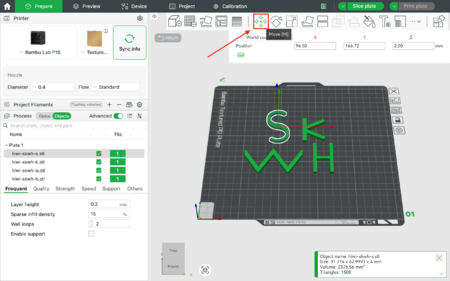
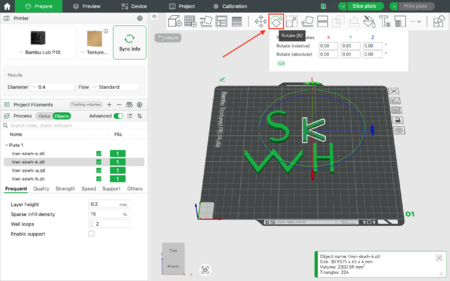
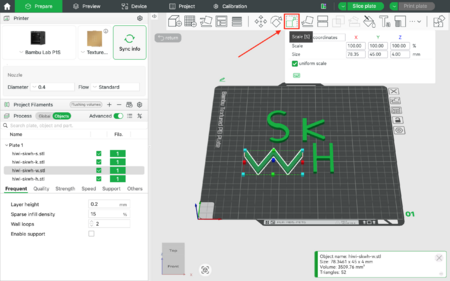
- Now you can correct the position, rotation and scale of your models.
- Make sure all models are placed on the plate.
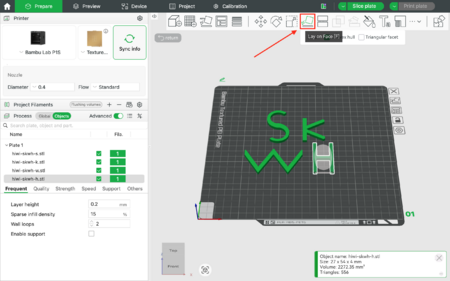
- Select your object to change the filament you want to use. Check the order of filaments that are inserted in the AMS.

- If you see a block next to your objects, it means that more than one filament will be used for your print. Please don't do that, as the printer will change the filament for each layer, resulting in a significant amount of filament waste.

- To change the infill density and pattern, go to Global, then Strength and scroll down to Sparse infill.

- Add support if needed.

- If you think that everything is as you want it, click on Slice plate.

- Here you can see how much filament is needed and how long the print will take.

- To export the 3MF file, select Export plate sliced file in the dropdown menu and click on Export plate sliced file again.


- When trying to export your file, you will be asked to choose an extension, please select Use .gcode.3mf.


- Save your file to the SD card, which is inserted in the printer. Press on it to pull it out.

- Make sure to insert the card correctly.

- Use arrows to get to the icon in bottom left corner and select your file, which should appear at the top, by pressing OK. It may take a while.

- Please observe the first 3 layers of the print.
- When the print is finished, wait a moment before picking up the print as the steel sheet is still hot. To pick it up, lift the steel sheet and bend the plate slightly to remove the printed parts from it.
- Please remove the remaining filament that is stuck to the steel sheet.


